
Contact Us
Stop the settling. Build with confidence.
For homeowners and residential builders who need a permanent foundation fix — installed quickly, cleanly, and in spaces where nothing else fits.
Warning signs
Signs your foundation is moving
Foundation problems rarely announce themselves all at once. If you are seeing more than one of these, the movement is usually structural rather than cosmetic.
Stair-step cracks in block or brick
Diagonal cracking that follows the mortar joints, usually wider at one end. This is the classic signature of one part of the foundation dropping faster than the rest.
Doors and windows that stick
Frames rack out of square as the foundation beneath them settles, so a door catches at one top corner or a window will not close cleanly.
Sloping or bouncing floors
A floor that runs downhill toward one wall, or feels springy underfoot, points to settlement or a failing support below the framing.
Gaps at trim and ceilings
Crown molding separating from the ceiling, or baseboard pulling away from the wall, means the structure is moving unevenly rather than shrinking with the seasons.
Cracks that keep growing
A hairline crack that has not changed in ten years is very different from one that widens season to season. Movement that continues needs a structural fix, not filler.
Bowing or leaning basement walls
Lateral pressure from saturated soil pushes a wall inward. This is a different failure than settlement and needs different hardware, so it is worth having looked at specifically.
Settling foundation? Building on bad soil?
A permanent fix, without tearing your home apart
Cracks widening, doors sticking, floors sloping? Or planning an addition on soil that will not cooperate? Residential helical piles solve both — stabilizing an existing foundation with remediation brackets, or carrying new construction on engineered footings.
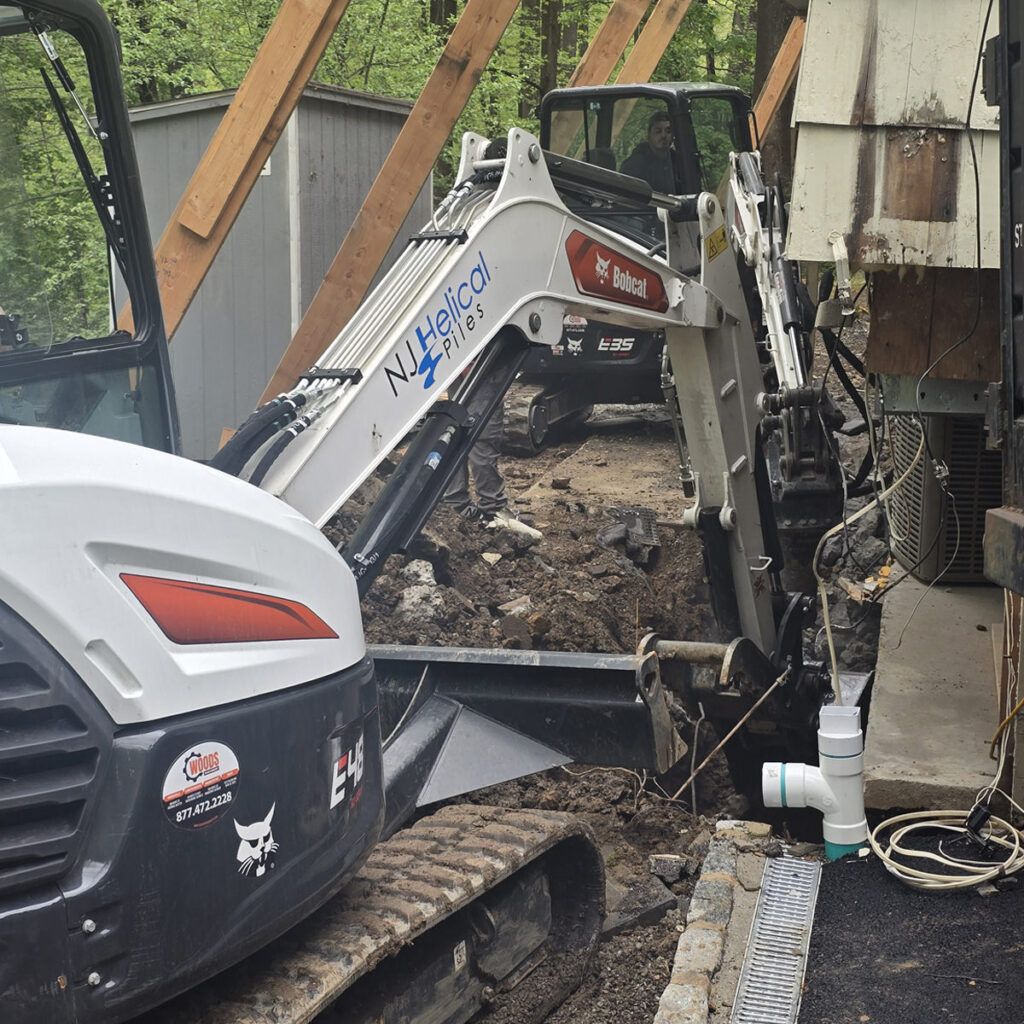
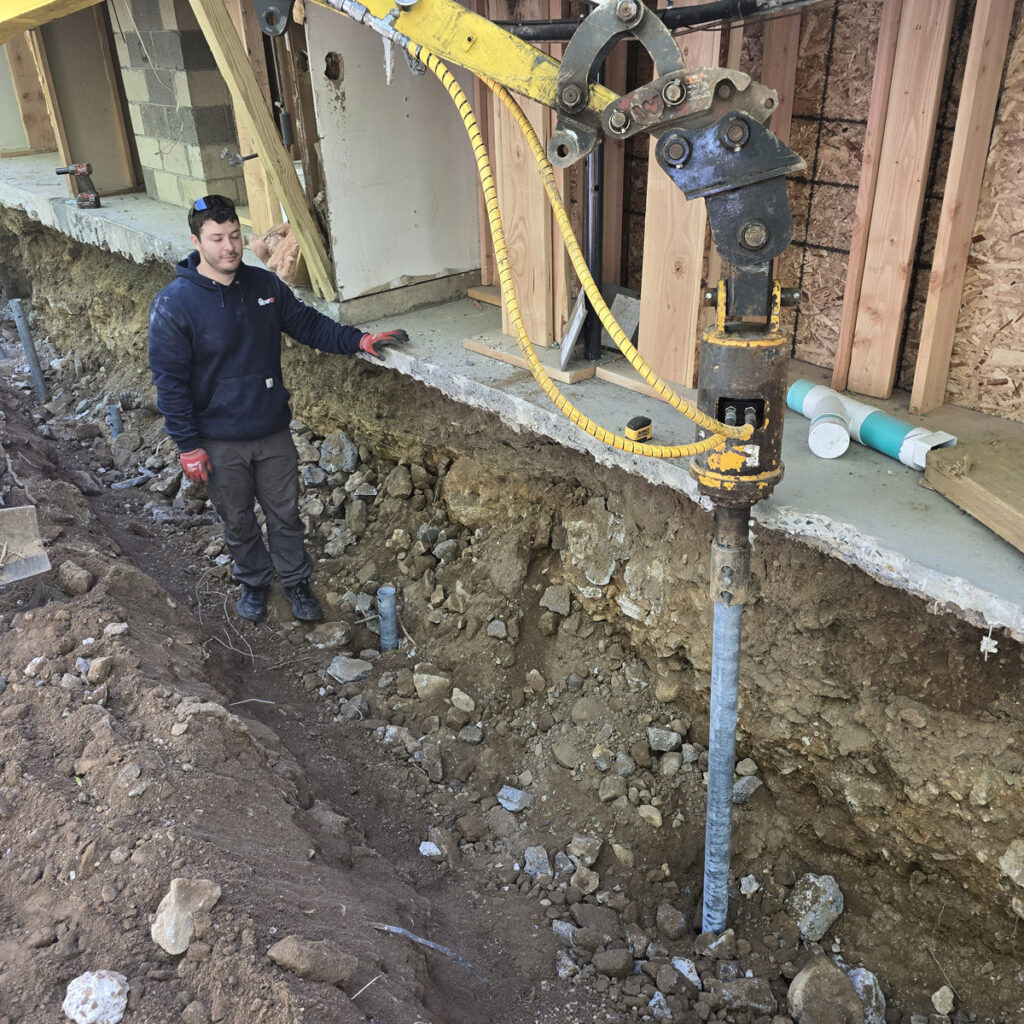
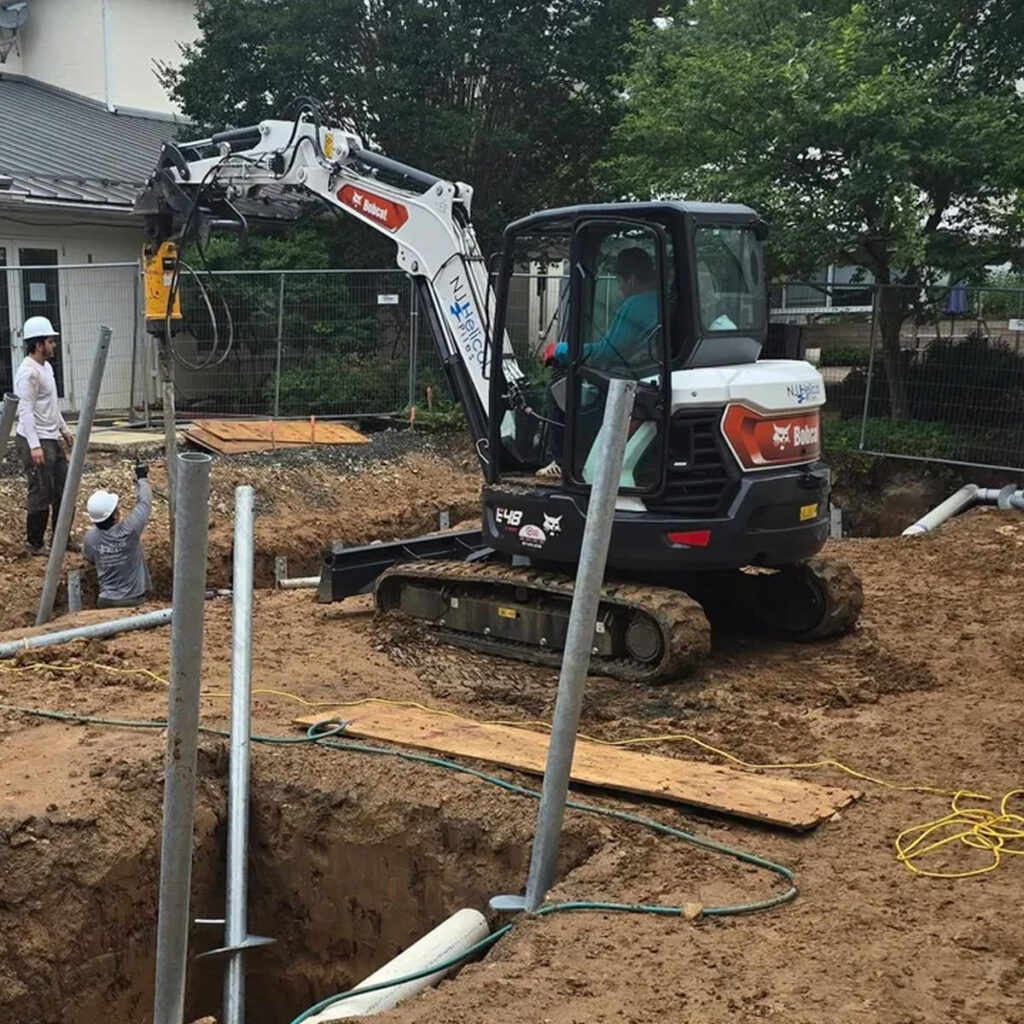
A helical pile is a steel shaft with one or more helical plates, rotated into the ground with hydraulic equipment until it reaches soil capable of carrying the load. On an existing house, brackets transfer the weight of the foundation onto those piles and the structure stops moving. On new work — an addition, a deck, a detached garage — the piles become the footing itself, and you build on them the same day.
Because they are rotated in rather than hammered, installation is low-vibration and low-mess. There is no excavation to speak of, no spoils pile in the yard, and no concrete truck. Our compact equipment reaches basements, crawl spaces, and tight side yards, so we can work where traditional underpinning simply cannot — the smallest tracked machine fits through a 40-inch opening, which covers most standard doorways.
That matters in this part of the country. Northern and central New Jersey sits on a mix of glacial soils, clay, shale, and decades of older fill in developed areas. A footing poured on material that later consolidates will move, and no amount of patching the crack fixes what is happening underneath it. Helical piles bypass that layer and transfer the load to competent soil below, with capacity confirmed by torque as each pile goes in.
Every pile is certified by a licensed Professional Engineer after installation, so you have documentation for your township inspector, your buyer, or your insurer — not just a contractor's word that the problem is solved.
What homeowners notice
Fast, clean, and permanent
01
Quick install
Most residential jobs are done fast, with construction able to continue right away.
02
Minimal disruption
Low vibration and no heavy excavation means less mess in your yard and home.
03
Engineered to last
A permanent, load-bearing solution — not a patch.
Applications
Commonly used for
Foundation repair and underpinning
Home additions and new footings
Deck and porch foundations
New construction on difficult soil
Where we work
Residential helical pile installation across NJ, Eastern PA and Northern DE
We install foundation piles for homeowners and residential builders throughout northern and central New Jersey — Hunterdon, Warren, Somerset, Morris, Sussex, Union, Middlesex, and Mercer counties — across the Lehigh Valley and southeastern Pennsylvania, and into northern Delaware.
Older housing stock and hilly, variable ground make foundation movement a common problem in this region. Homes built on cut-and-fill lots, on shallow footings over clay, or on ground that was regraded decades ago all tend to move in the same predictable ways. If your neighbors have had foundation work done, there is usually a reason for it.
Not sure whether you are in range? Call and ask — we travel for the right project.
FAQ's
Why helical piles instead of traditional footings?
Here are answers to the questions we hear most from homeowners and contractors comparing helical piles to poured concrete footings. If you have a question not answered here please feel free to contact us directly either by phone or email.
How much faster is installation compared to traditional footings?
Much faster. There’s no need to wait for an inspection or for concrete to cure — helical piles can be built upon right after they’re installed.
Are helical piles stronger than standard concrete footings?
Standard footings in NJ are typically 36″ to 42″ deep. If they’re installed on loose soil, there’s a chance they’ll sink. Helical piles are screwed into the ground until they reach strong, compacted soil, regardless of depth — and they’re installed to a specific torque value stipulated by a Professional Engineer.
Do helical piles meet the new building code requirements for decks?
Recent changes to the national building code mandate wider footings for decks and other structures — meaning more digging and more concrete under the old approach. Our helical piers far surpass what the new code requires.
How do I know my helical piles will actually hold the load?
Each pile is certified by a Professional Engineer after installation. That takes the guesswork out of your soil conditions — you get documented, verified capacity, not an assumption.
Will installation leave a mess of excavated soil on my property?
No. Helical piles displace very little dirt compared to concrete footing holes, so there’s no large pile of excess soil to find somewhere to dump.
Can helical piles be installed in winter or cold weather?
Yes. Concrete requires a temperature above 40°F to cure, which means most builders can’t start until late spring. We can install helical pile footings right through snow and frost — so your project can start early and you can get ahead of the summer rush.
Can you install in tight or hard-to-access areas?
Yes. Our smallest tracked machine fits through a 40″ opening, and we also have handheld units for very tight spaces where even that won’t fit.
Not sure if helical piles are right for your home?
Tell us what you are seeing — the cracks, the sticking doors, the sloping floor. Photos help if you have them, and you can email them straight to us.