
Contact Us
High-capacity foundations, verified as they go in
For engineers, project managers, developers, and general contractors who need serious load capacity, documented proof, and a schedule that holds.
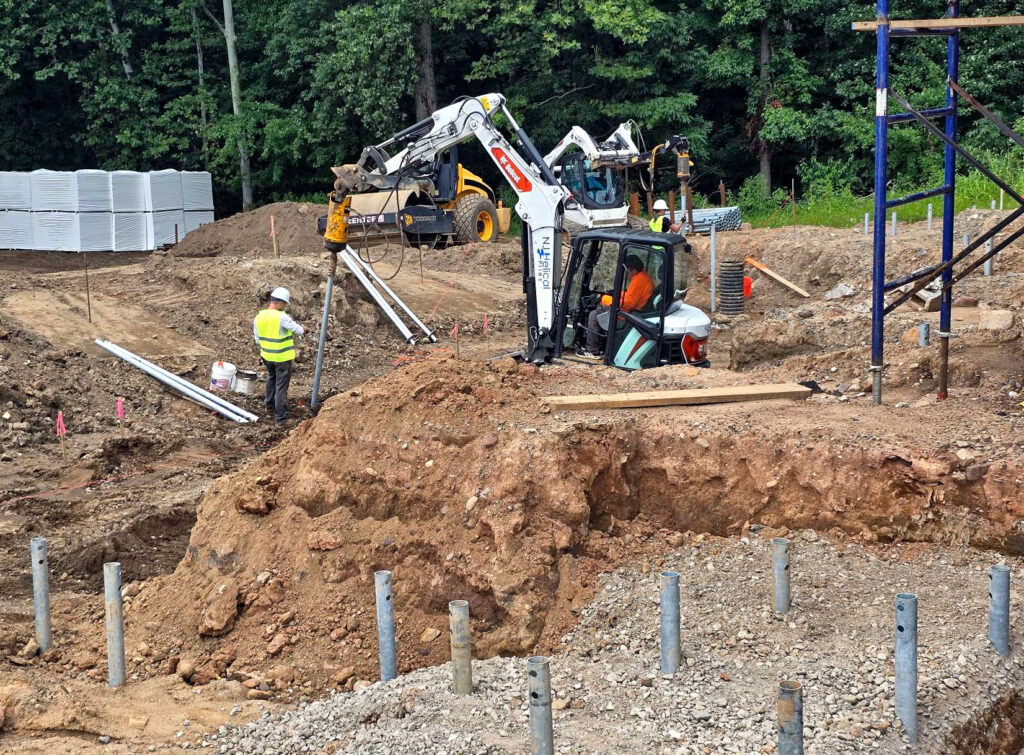
Speed, capacity, certainty
Foundations that keep serious projects on schedule
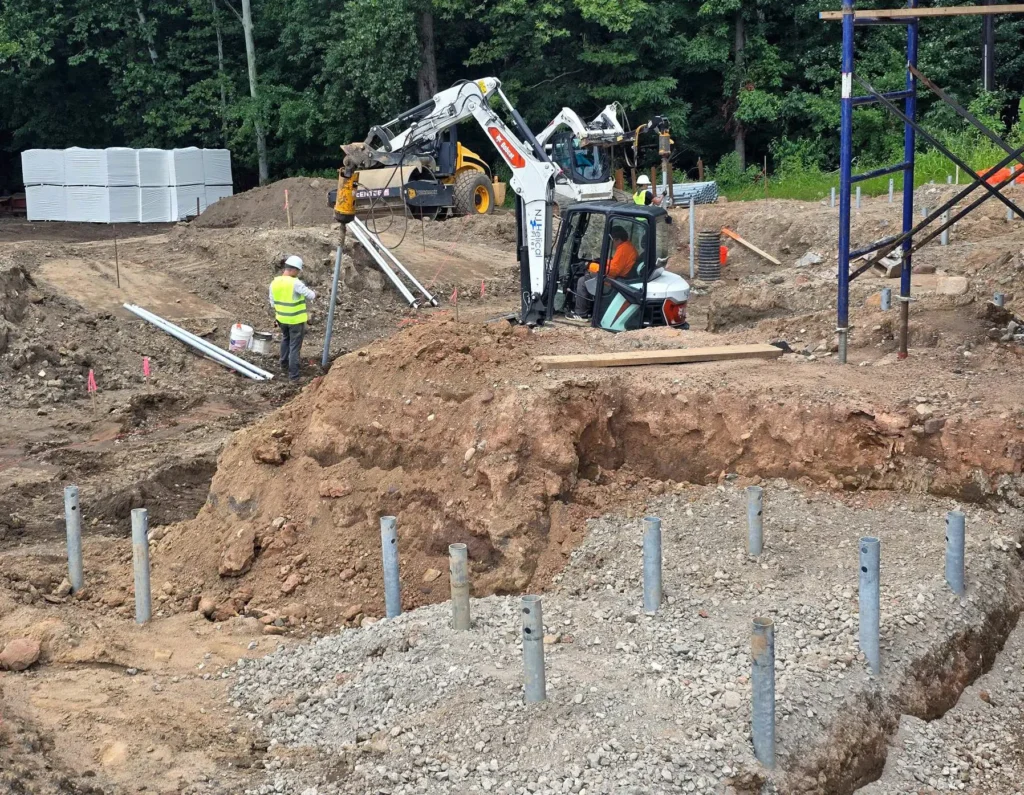
When the loads are heavy and the timeline is unforgiving, helical piles remove the usual bottlenecks. There's no concrete cure time, no excavation spoils to haul off, and no waiting on secondary load testing. Capacity is confirmed at installation through calibrated torque monitoring, and every pile is documented with depth, torque, and verified capacity for your records.
That documentation is what engineers and project managers really buy: not just a pile in the ground, but proof it performs to the design load — delivered the day it goes in.
35+ years
In commercial, industrial, and residential construction
100,000+ lb
Per-pile capacity, tension and compression
Torque-verified
Every pile documented to design load as installed
40-inch access
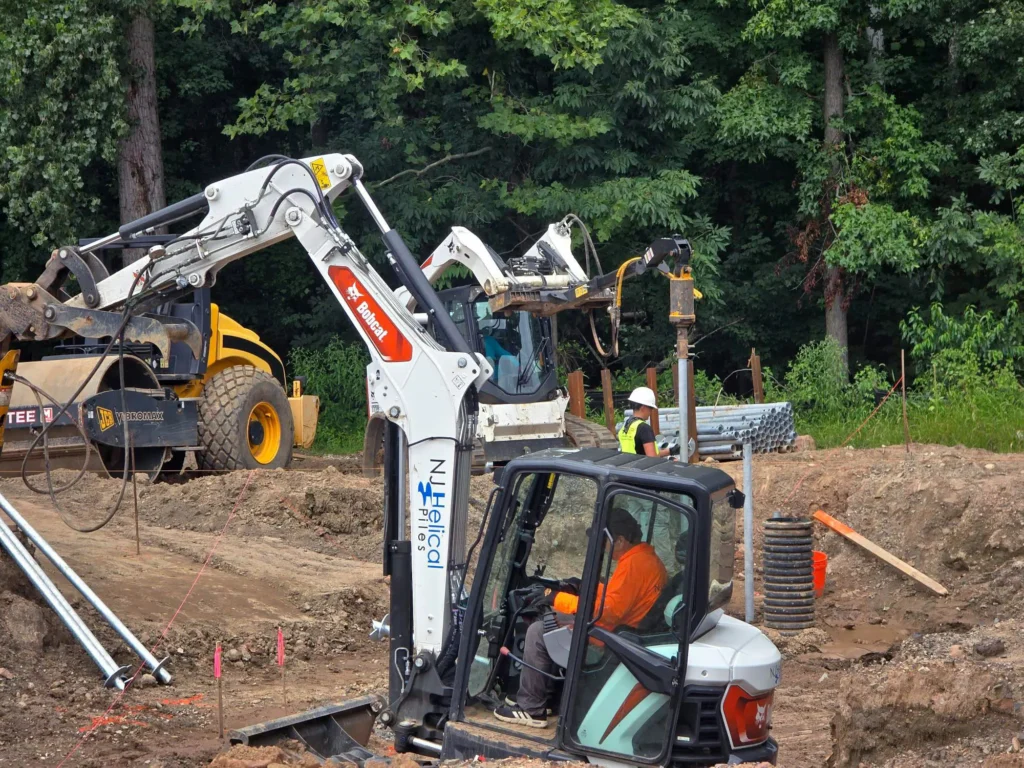
Smallest tracked machine fits through a standard doorway
Applications
Commonly specified for
Commercial and industrial deep foundation work across New Jersey, Eastern Pennsylvania, and Northern Delaware.
01
New construction on poor or fill soils
Former industrial sites, capped fill, and soft alluvial soils will not carry conventional footings without over-excavation. Helical piles bypass the weak layer and transfer load to competent strata below.
02
Solar array foundations
No concrete, immediate load, and tension capacity equal to compression. Torque readings give the racking engineer verified uplift capacity pier by pier.
03
Additions and vertical expansion
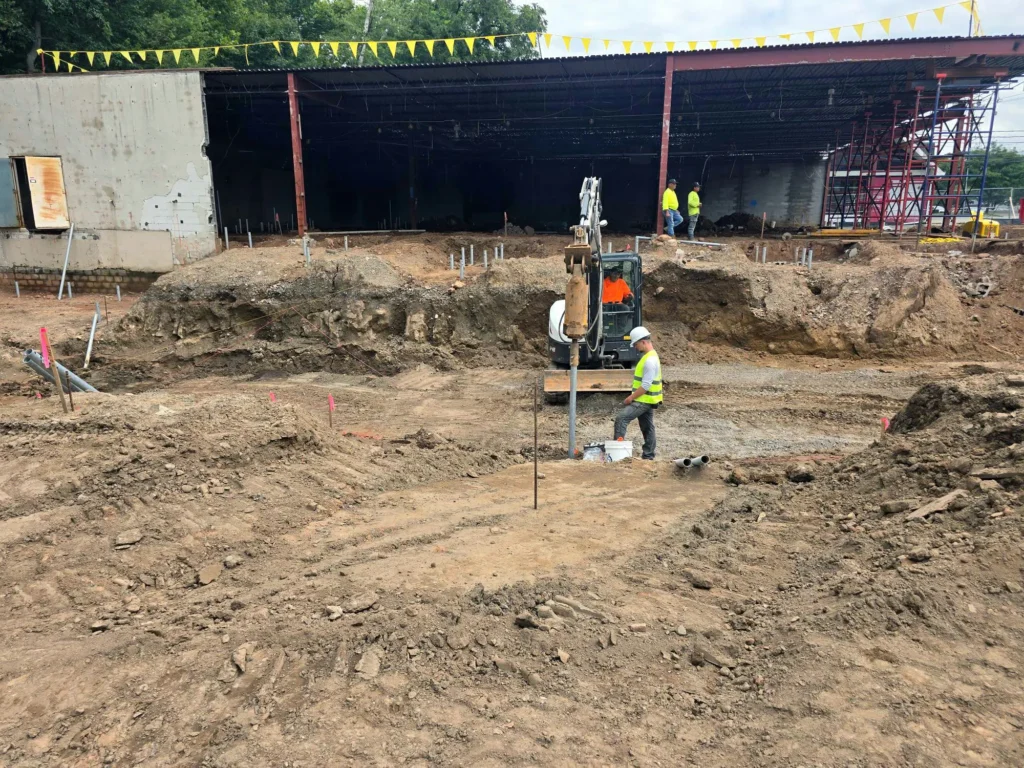
Compact rigs install from inside existing structures and in low-clearance areas, with no driving vibration to threaten the building you are tying into.
04
Industrial equipment pads
Our smallest tracked machine fits through a 40-inch opening, so we install inside existing buildings, under low clearance, and on tight urban sites where conventional foundation equipment cannot reach.
05
Boardwalks, docks, and marine
High water table, saturated soils, and restricted access are the normal case here. Installs without dewatering or placing concrete in water, and carries the uplift that wave and ice action generate.
06
Retaining walls and tiebacks
Helical anchors resist lateral earth pressure in tension. The same torque-to-capacity relationship applies, so the wall designer gets verified anchor capacity rather than assumed embedment.
07
Light poles and site signage
Small, repetitive, and usually the last thing standing between you and occupancy. No cure time means the poles go up the day the foundations do.
08
Municipal and infrastructure
Public work carries documentation requirements that commercial jobs often do not. Per-pile records of equipment, dimensions, tip elevation, depth, and final installation torque form the closeout package inspectors expect.
Code and documentation
Designed and documented to code
Helical pile foundations are governed by Section 1810 of the International Building Code, and helical pile systems are evaluated against ICC-ES Acceptance Criteria AC358 for recognition in an evaluation report. Capacity is established either by load testing or by torque correlation, where installation torque is monitored continuously and correlates directly to ultimate capacity. That correlation is why helical piles are verifiable in a way most deep foundations are not — there is no waiting on a secondary load test to learn whether the pile performs.
On every project you receive per-pile records covering:
- Installation equipment used
- Pile dimensions and helix configuration
- Tip elevation and final installed depth
- Final installation torque
- Correlated capacity against the specified design load
- Installation date and as-built pile location
Service area
Commercial helical pile projects across NJ, Eastern PA and Northern DE
NJ Helical Piles installs deep foundations throughout northern and central New Jersey — including Hunterdon, Warren, Somerset, Morris, Sussex, Union, Middlesex, and Mercer counties — across the Lehigh Valley and southeastern Pennsylvania, and into northern Delaware.
Regional site conditions drive a lot of foundation decisions here. Piedmont soils across the northern and central part of the state give way to coastal plain sediments to the south and east, and a long industrial history has left a great deal of fill behind. Where a boring log shows soft or variable material over competent strata, a helical pile is often the shortest path between the geotechnical report and a foundation you can build on.
Getting a quote
Spec'ing a project? Here's what gets you a real number.
Email us what you have. With these four things we can usually return documented capacities and a quote without a site visit.
- Foundation plan or structural drawings, even preliminary
- Geotechnical report or boring logs, if one exists
- Design loads — compression, tension, and lateral, if known
- Site access notes — overhead clearance, working room, surface conditions
No geotechnical report yet? Send the rest, or just call. We will tell you what can be determined now and what still needs a boring.
Common questions
Helical piles, answered
How much load can a helical pile carry?
Capacity depends on soil conditions, shaft size, and helix configuration. Typical commercial installations range from 5,000 to over 100,000 lb per pile in both tension and compression. Actual capacity is confirmed at installation.
How is capacity verified?
Installation torque is monitored continuously and correlates directly to ultimate capacity. Each pile is documented with its final torque and the correlated capacity against the specified design load.
How soon can we build on them?
Immediately. There is no concrete cure time, so structures can often be loaded the same day the piles are installed.
Can helical piles be installed inside an existing building?
Yes. Our smallest tracked machine fits through a 40-inch opening, which covers most standard doorways, so we can work in interior and low-clearance conditions where conventional foundation equipment cannot operate. Installation is rotational rather than driven, so there is no vibration risk to the surrounding structure.
Do they work in winter?
Yes. Installation continues in virtually any season, which is a common reason helical piles get specified when a schedule would otherwise slip a quarter.
What areas do you serve?
Commercial and industrial projects across New Jersey, Eastern Pennsylvania, and Northern Delaware.
Spec'ing a project? Let's talk piles.
Email your engineer's drawings, soil data, and load requirements — or just tell us about the site. We will help determine whether helical piles are the right solution and get you a quote.